London
Master William Blake's 'London' with this comprehensive guide covering context, language analysis, and exam strategy. Discover how to move beyond basic plot retelling to deliver the conceptualised, perceptive analysis of 'mind-forg'd manacles' that examiners reward with top marks.
Study Notes
Overview
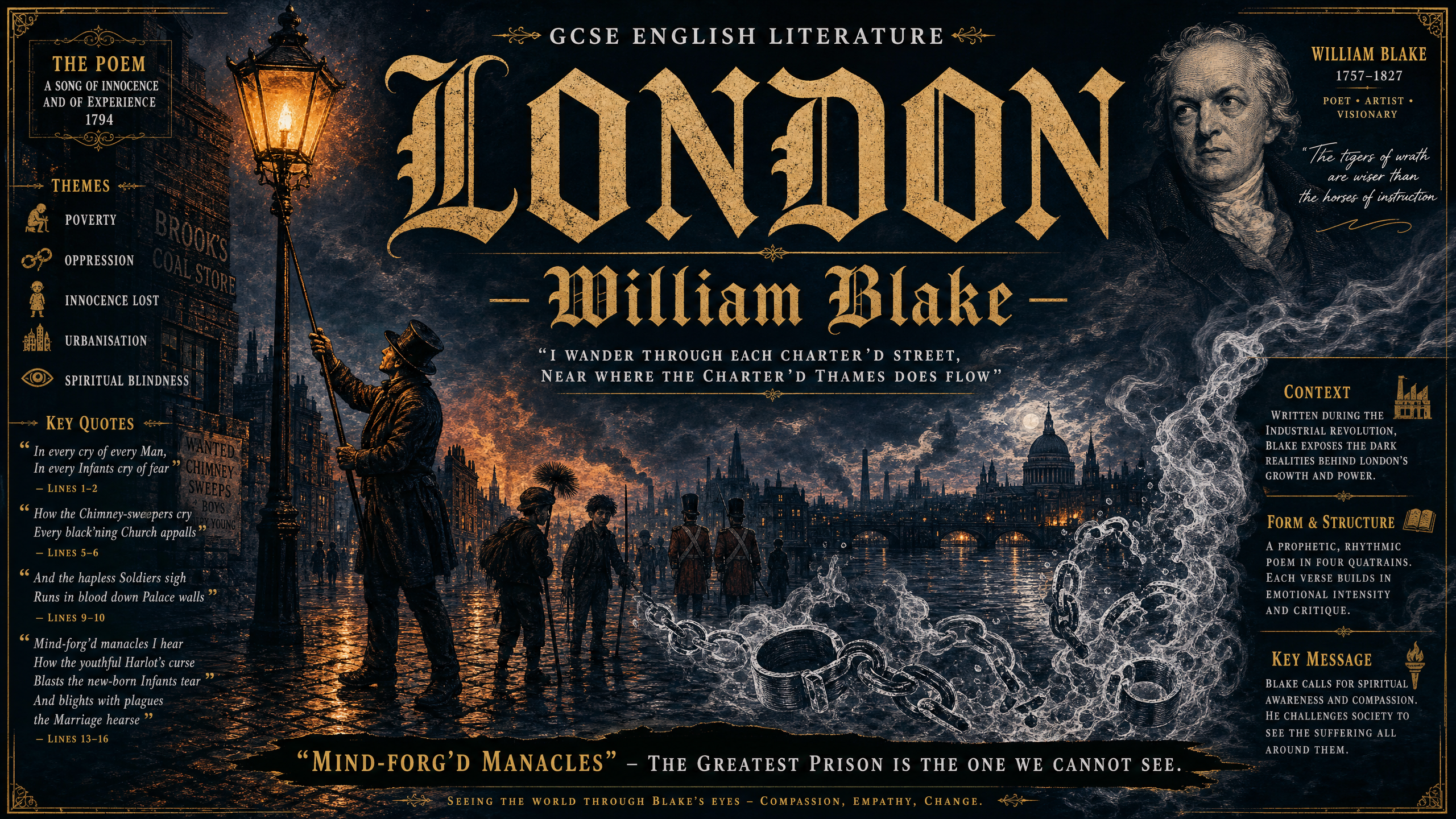
William Blake's 'London', published in 1794 as part of his Songs of Experience collection, is a furious critique of 18th-century urban life and institutional oppression. The poem presents a devastating vision of a city corrupted by capitalism, the Church, and the monarchy, where even the minds of the citizens are chained by ideology. For GCSE English Literature candidates, this poem is a goldmine. Examiners consistently reward students who can move beyond treating the poem as a simple description of a walk through the city, and instead analyse it as a radical political statement. To achieve top bands (AO1 and AO2), you must explore Blake's deliberate language choices—such as the ambiguous 'charter'd' and the oxymoronic 'Marriage hearse'—and link these to his broader social critique (AO3).
Listen to the companion podcast below for an in-depth audio revision session:
Poem Content Overview
- Stanza 1: The speaker wanders through the 'charter'd' (controlled, owned) streets near the Thames, observing signs of weakness and woe in every face he passes.
- Stanza 2: The speaker describes the universal sounds of suffering—cries of men and infants—and introduces the central concept that the citizens are trapped by 'mind-forg'd manacles'.
- Stanza 3: The poem focuses on specific victims of institutional power: the young chimney sweep whose cry indicts the corrupt Church, and the hapless soldier whose blood stains the Palace walls.
- Stanza 4: Moving into the midnight streets, the speaker hears the curse of the youthful harlot, which corrupts the innocence of the newborn and transforms the celebration of marriage into a 'hearse'.
Themes
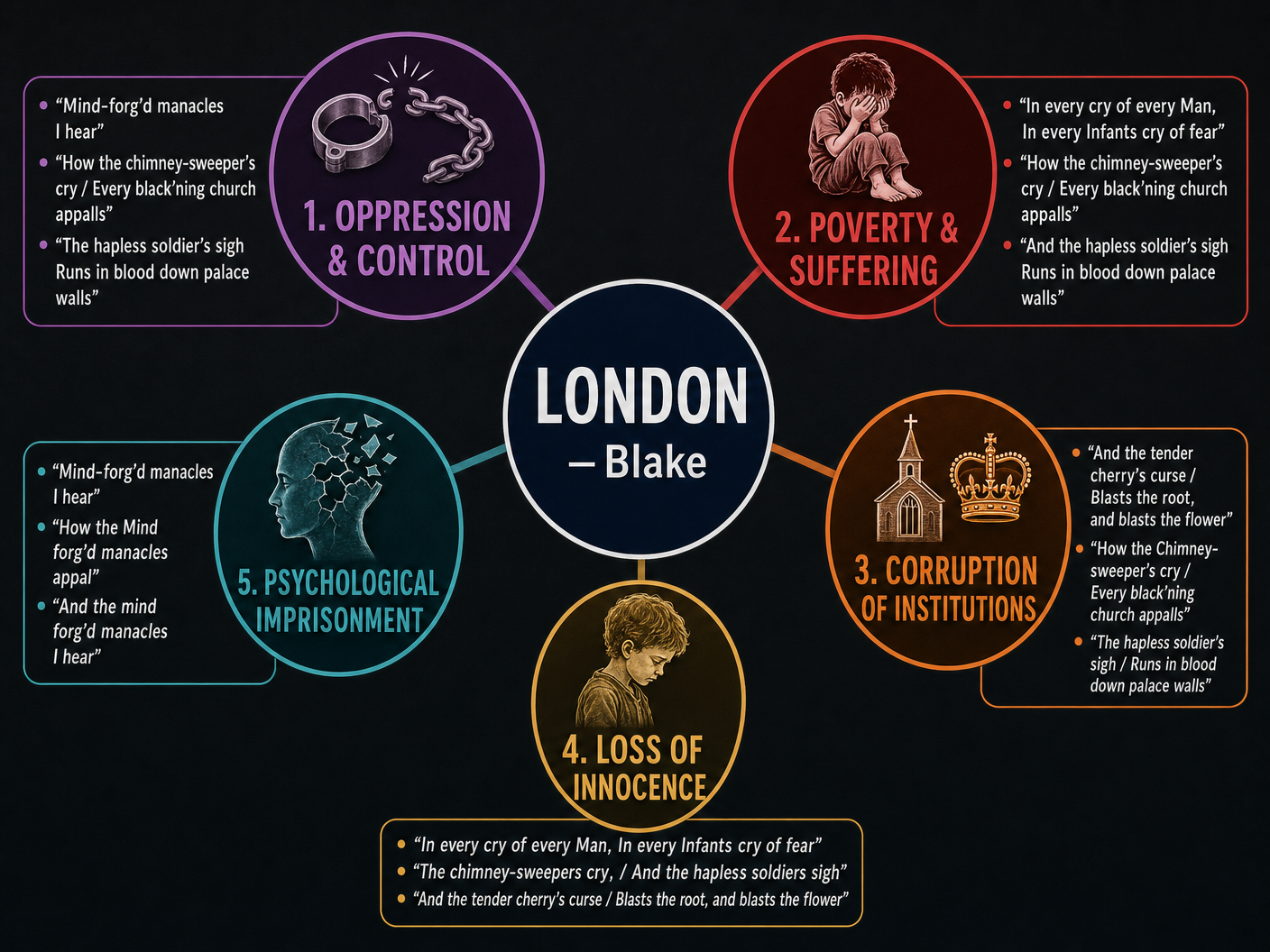
Theme 1: Oppression and Control
Blake presents London as a place where freedom has been entirely eradicated by powerful institutions. This control is not just physical, but psychological. The state and capitalism have commodified public spaces, while the Church and monarchy have conditioned the poor to accept their suffering.
Key Quotes:
- "I wander through each charter'd street" (Stanza 1) - The repetition of 'charter'd' emphasises how commerce and state power have mapped and claimed even the natural world (the Thames).
- "The mind-forg'd manacles I hear" (Stanza 2) - A powerful metaphor suggesting that the citizens' chains are psychological; they have internalised their own oppression through ideology.
Theme 2: The Corruption of Institutions
Blake launches a direct attack on the pillars of 18th-century society: the Church of England and the monarchy. He portrays them as hypocritical and complicit in the suffering of the most vulnerable.
Key Quotes:
- "Every black'ning Church appalls" (Stanza 3) - The Church is literally blackened by soot, but metaphorically 'blackened' by its moral failure to protect the child chimney sweeps.
- "Runs in blood down Palace walls" (Stanza 3) - A visceral metaphor accusing the monarchy of sacrificing 'hapless' soldiers for its own power.
Theme 3: Loss of Innocence
As part of Songs of Experience, the poem focuses heavily on the destruction of childhood innocence by a corrupt adult world. Children are forced into deadly labour or born into disease and poverty.
Key Quotes:
- "How the Chimney-sweeper's cry" (Stanza 3) - Represents the exploitation of children (some as young as five) in dangerous, life-threatening work.
- "Blasts the new-born Infant's tear" (Stanza 4) - The cycle of suffering begins immediately at birth, with innocence destroyed by the 'curse' of the harlot (representing disease and social decay).
Writer's Methods: Form and Structure
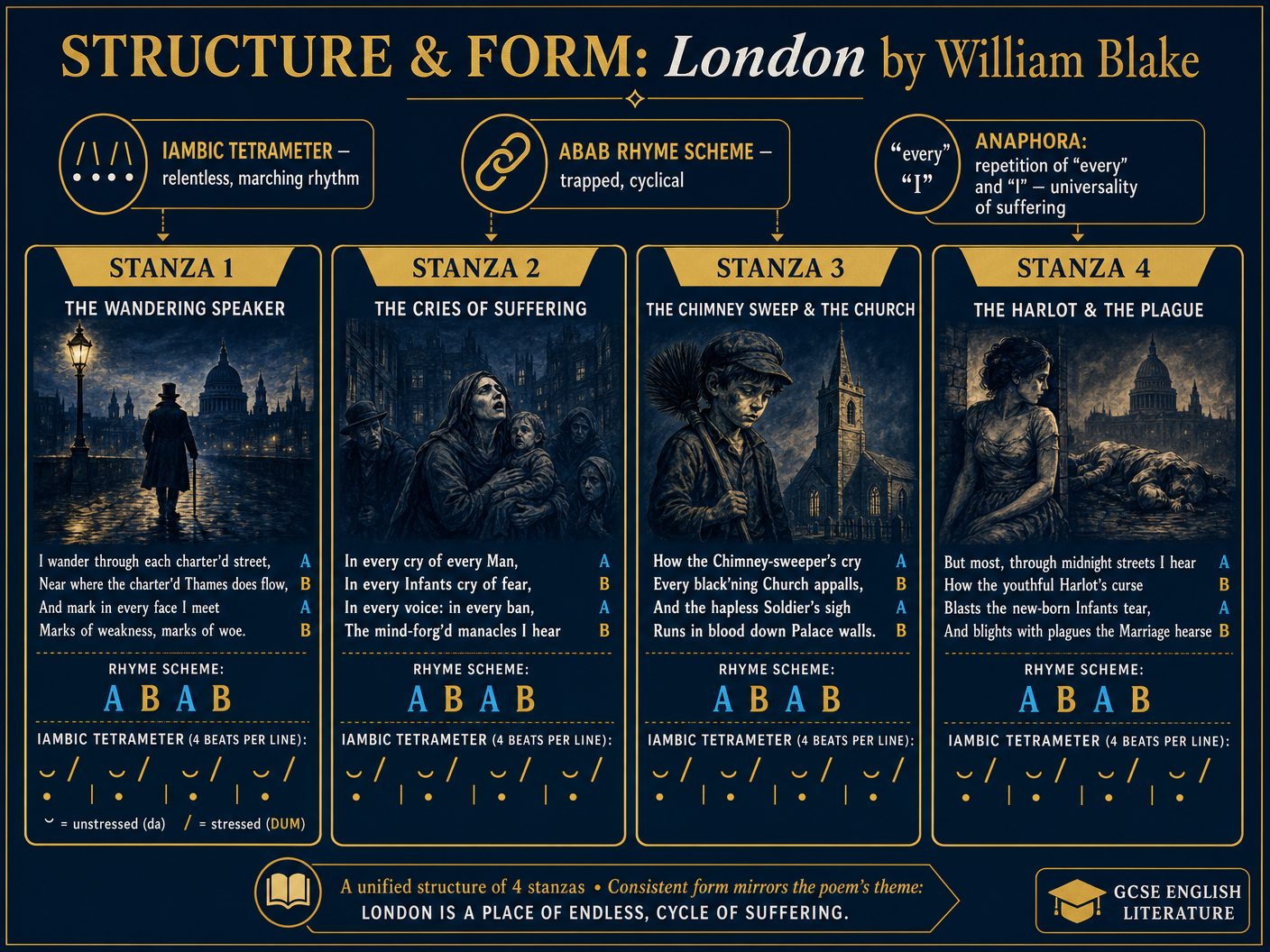
Blake's structural choices are highly deliberate and reflect the poem's themes of entrapment and relentless suffering.
- Iambic Tetrameter: The poem is written in a strict, marching rhythm (four beats per line). This creates a sense of inevitability and mirrors the speaker's relentless walking through the city. It also reflects the inescapable cycle of suffering.
- ABAB Rhyme Scheme: The highly regular, unbroken rhyme scheme visually and audibly traps the poem, much like the citizens are trapped in London.
- Anaphora: The repetition of "In every..." in Stanza 2 creates a cumulative, suffocating effect, emphasising the universality of the suffering.
- Cyclical Structure: The poem begins with the speaker's observations and ends with the ultimate symbol of cyclical destruction: the 'Marriage hearse', suggesting that even new life is doomed to death.
Context
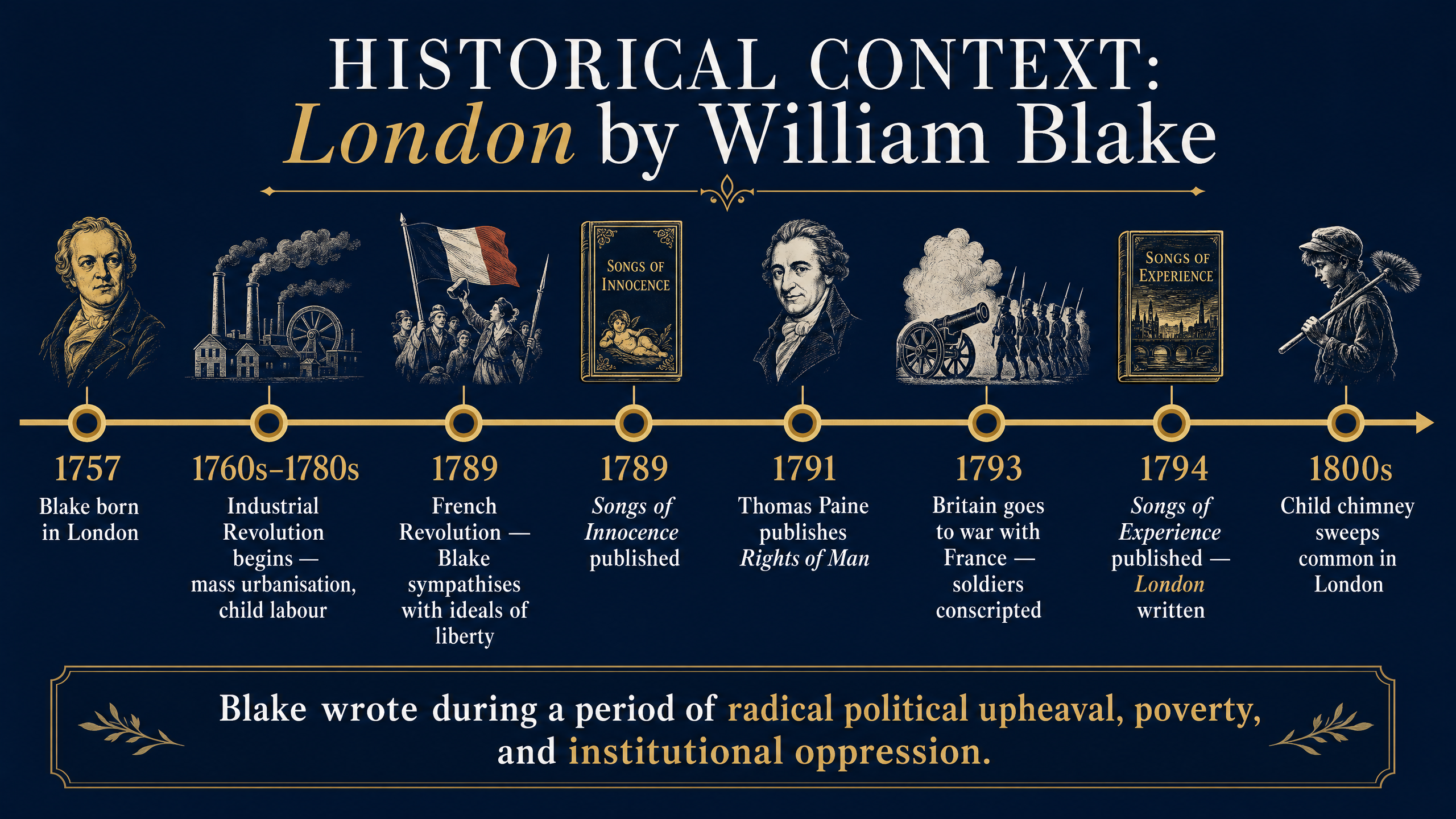
To achieve high marks for AO3, you must integrate relevant contextual knowledge into your analysis:
- The Industrial Revolution: London was undergoing rapid, chaotic urbanisation. This led to extreme poverty, child labour (chimney sweeps), and terrible living conditions.
- The French Revolution (1789): Blake was a radical who sympathised with the revolutionary ideals of liberty and equality. London can be read as a warning that Britain's oppressive systems could lead to similar violent uprisings (hinted at by the blood on the Palace walls).
- Songs of Innocence and of Experience: The poem must be understood as part of a broader project exploring the 'two contrary states of the human soul'. London represents the darkest depths of 'Experience', where society has entirely corrupted natural human innocence.
- Blake's Religious Views: Though deeply spiritual, Blake despised the organised Church of England, viewing it as a tool of state control that preached passive obedience to the poor.
Visual Resources
3 diagrams and illustrations
Interactive Diagrams
1 interactive diagram to visualise key concepts
Conceptual Flow Outline
The Cycle of Institutional Oppression in 'London'
Worked Examples
1 detailed example with solutions and examiner commentary
Practice Questions
Test your understanding — click to reveal model answers
Compare how poets present the theme of human suffering in 'London' and one other poem from your anthology.
Hint: Consider 'Remains' (Armitage) for psychological suffering, or 'Exposure' (Armitage) for the suffering of soldiers. Focus on how the *causes* of suffering differ.
How does Blake use language and structure to present the city of London?
Hint: Look at the progression from the physical streets in Stanza 1 to the psychological state in Stanza 2, to the specific victims in Stanzas 3 and 4.
Explore the significance of the phrase 'mind-forg'd manacles' in the context of the whole poem.
Hint: Break down the metaphor. What are manacles? How are they forged in the mind? Who put them there?
How does Blake present the corruption of innocence in 'London'?
Hint: Focus on the figures of the infant, the chimney sweep, and the youthful harlot.